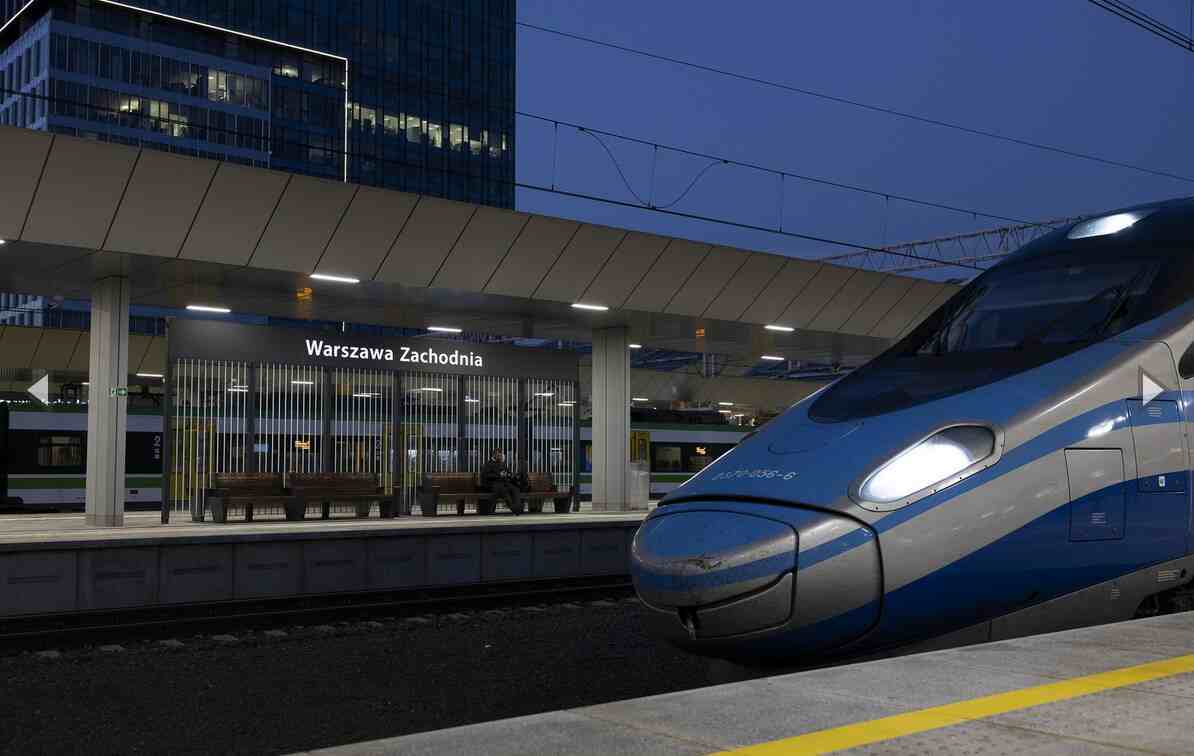
PKP has announced the completion of the long-awaited reconstruction of Warszawa Zachodnia, one of Poland’s largest and busiest railway stations. The project, which lasted five years and cost nearly €600 million, marks one of the most significant investments in the Polish railway network.
A major highlight of the upgrade is the opening of a new underground passageway connecting the station with the districts of Ochota and Wola. The 500-metre tunnel — the longest passenger underpass in the PKP network — resembles a compact shopping centre, housing 26 service points, ticket offices, restrooms and waiting areas beneath 20 tracks. Construction required 11,500 tonnes of steel, more than was used to build the Eiffel Tower. The tunnel spans 66 metres in width.
The broader station modernisation includes fully upgraded platforms equipped with new seating, digital information boards, timetable screens and audio announcements. Seven platforms were renovated and one entirely new platform was added. New escalators and lifts provide direct access to the passageway, while solar panels installed on platform roofs now supply one-third of the station’s electricity needs.
During the reconstruction, trains continued operating without interruption, although the works resulted in years of logistical complexity for passengers, railway staff and construction teams. “It was a difficult period for everyone. Now new challenges lie ahead,” said Deputy Infrastructure Minister Piotr Malepszak.
Funding for the reconstruction was partly provided by the European Commission as part of the Infrastructure and Environment programme. Around €354 million was allocated for the station itself, €118 million for track upgrades and nearly €236 million for the underground tram station. In total, the project included the installation of 36 kilometres of new tracks and 137 new switches, as well as state-of-the-art safety and control systems.
With the works now complete, Warszawa Zachodnia is fully operational, offering passengers a modern, accessible and energy-efficient transportation hub designed to meet the capital’s growing mobility needs.