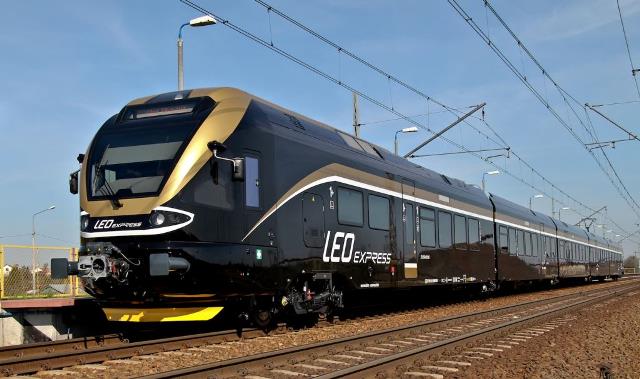
From June 25, the private operator has begun running trains between Frankfurt and Prague, with a further extension to Przemyśl planned once regulatory issues in Poland are resolved. In the meantime, the company is bridging the Polish section of the route with connecting buses between Bohumín and Przemyśl, allowing passengers with existing bookings to continue their journeys while the final approvals are pending.
The new service reflects Leo Express’s broader ambition to build cross-border rail corridors that can compete with air, bus and car travel while also improving direct links between Western Europe, Central Europe and eastern gateway cities close to Ukraine.
Leo Express launches new Frankfurt-Prague connection
The new route officially entered service on June 25 and is currently operating between Frankfurt Airport, Prague and Bohumín, with the operator planning to extend trains onward to Przemyśl as soon as the regulatory process in Poland is completed.
For now, the core rail service links Bohumín in the Czech Republic with Prague, Dresden and Frankfurt Airport, creating a direct overnight-style connection between Germany and the Czech market. The route is being operated with modernised RIC international coaches equipped with air conditioning and Wi-Fi, alongside onboard refreshments and multilingual staff able to assist passengers in Polish, Czech, English and German.
Leo Express says the long-term value of the route lies in connecting major European economic and cultural centres with the eastern edge of the EU rail network, especially for passengers travelling toward southeastern Poland and the Ukrainian border.
Przemyśl rail extension delayed by regulatory process in Poland
Although Leo Express is marketing the route as Frankfurt-Prague-Przemyśl, the final Polish rail section is not yet being operated by train. The company says it is ready to begin through train services to Przemyśl immediately once Poland’s economic equilibrium test is resolved.
That test, which is still ongoing, currently prevents the operator from running the train section between the Czech border and Przemyśl. As a result, Leo Express is temporarily substituting that part of the route with a dedicated bus service running between Bohumín, Kraków, Tarnów, Rzeszów and Przemyśl, connecting with its trains in both directions.
The arrangement is designed to preserve the travel option for passengers who have already purchased tickets, while allowing Leo Express to maintain momentum behind the launch of the wider corridor even before full regulatory clearance is in place.
Buses temporarily replace the Polish rail section
Until the Polish approval process is completed, passengers travelling beyond Bohumín toward southeastern Poland will continue their journey by bus. Leo Express says the temporary road section is timed to connect with the train service and ensure that passengers can still reach Kraków, Tarnów, Rzeszów and Przemyśl.
The company has also introduced a compensation mechanism for passengers whose tickets include stations not currently served by the replacement buses. In those cases, Leo Express says it will refund the ticket price and provide an additional 100% of the fare in leo credits, which can be used for future tickets or onboard purchases.
Operationally, the bus bridge is a stopgap solution rather than a long-term product. The company has made clear that it intends to sell tickets for the Polish section only once it can operate the full route by rail.
New route targets international and Ukraine-bound demand
Leo Express has been explicit about the market it sees for the new service. According to the operator, the line is aimed not only at passengers travelling between Germany and the Czech Republic, but also at Ukrainians and international travellers heading toward Przemyśl, which has become one of the most important rail gateways for onward travel to and from Ukraine.
That makes the route strategically more important than a standard Frankfurt-Prague service. Przemyśl has emerged as a key interchange point for rail travel into Ukraine since 2022, and direct westbound links to the city have taken on a much broader geopolitical and mobility role than they had previously.
By targeting that market, Leo Express is trying to position itself not just as a Central European private rail operator, but as a carrier building practical international corridors that connect Western Europe with eastern border hubs.
Modern RIC coaches now, Business Class and couchettes later
In the initial phase, the new trains are being operated with three first-class RIC coaches configured as Economy class, each offering 54 seats. These coaches are designed for international service and come with air conditioning, Wi-Fi and onboard catering already familiar to Leo Express passengers on other routes.
The company plans to expand the onboard offer during the summer by adding dedicated Business Class coaches and couchette or sleeping cars, a move that would significantly strengthen the route’s appeal for longer-distance and overnight travellers. Leo Express also says it is prepared to add more coaches depending on demand.
That phased rollout suggests the operator sees the route as a long-term corridor rather than a limited seasonal experiment. The initial product is functional, but the full vision clearly includes a more developed overnight rail offering that can compete more directly with other cross-border travel options.
Current timetable shaped by major infrastructure works in Germany
The service is launching in a difficult operating environment because of extensive infrastructure works in Germany, which have already forced timetable adjustments and temporary planning compromises.
Under the current schedule, the train departs Bohumín at 17:45, arrives in Prague at 22:32, stops in Dresden at 1:38 and reaches Frankfurt Airport at 8:06. In the opposite direction, the service leaves Frankfurt Airport at 14:39, arrives in Dresden at 22:30, Prague at 1:17 and Bohumín at 6:01.
Additional German stops currently include Leipzig, Fulda, Hanau, Offenbach and Frankfurt Süd. However, Leo Express has warned that closures and infrastructure works in Germany throughout the summer and autumn may affect timings and, on some days, even the specific stations served. Passengers are being advised to check the reservation system for the most up-to-date departure times.
Leo Express is betting on east-west rail corridors
The broader significance of the launch lies in what it says about Leo Express’s long-term strategy. The operator is not simply adding another international route. It is trying to build a trans-European corridor that links Western Europe with Central Europe and, eventually, with one of the key rail access points to Ukraine.
That is an ambitious play in a market where international rail is often fragmented by infrastructure constraints, national regulations and timetable conflicts. But it also taps into a growing demand for direct, lower-emission cross-border transport that avoids airport transfers and long car journeys.
If Leo Express succeeds in extending the route fully to Przemyśl by rail, the Frankfurt-Prague-Przemyśl service could become one of the more interesting new private-rail links in Central Europe – not because of its speed alone, but because of the geography it connects and the role it could play in reshaping east-west rail travel across the region.