Ukrzaliznytsia has officially presented a strategic plan aimed at tackling the critical shortage of passenger train tickets, a problem that sharply intensified during the summer of 2025. At a press conference in Kyiv on Friday, company leadership revealed that demand for tickets—particularly on the popular Kyiv–Lviv route—has dramatically outpaced supply. In just one week, from July 28 to August 3, there were 142,000 searches for tickets on this route, while only 18,465 seats were available.
The main cause of this shortage is a significant loss of passenger railcars over recent years. Between 2019 and 2024, 1,087 cars were removed from service: 28 destroyed due to conflict, 265 stranded on occupied territories, and 794 retired due to reaching the end of their service life. An additional 300 cars are expected to be phased out between 2025 and 2029 for similar reasons.
Ukrzaliznytsia has outlined four key measures to address this challenge:
Improving the efficiency of rolling stock utilization.
Large-scale procurement of new railcars: after a near halt in deliveries during 2012–2015, the company plans to purchase 100 cars annually from 2026 to 2028.
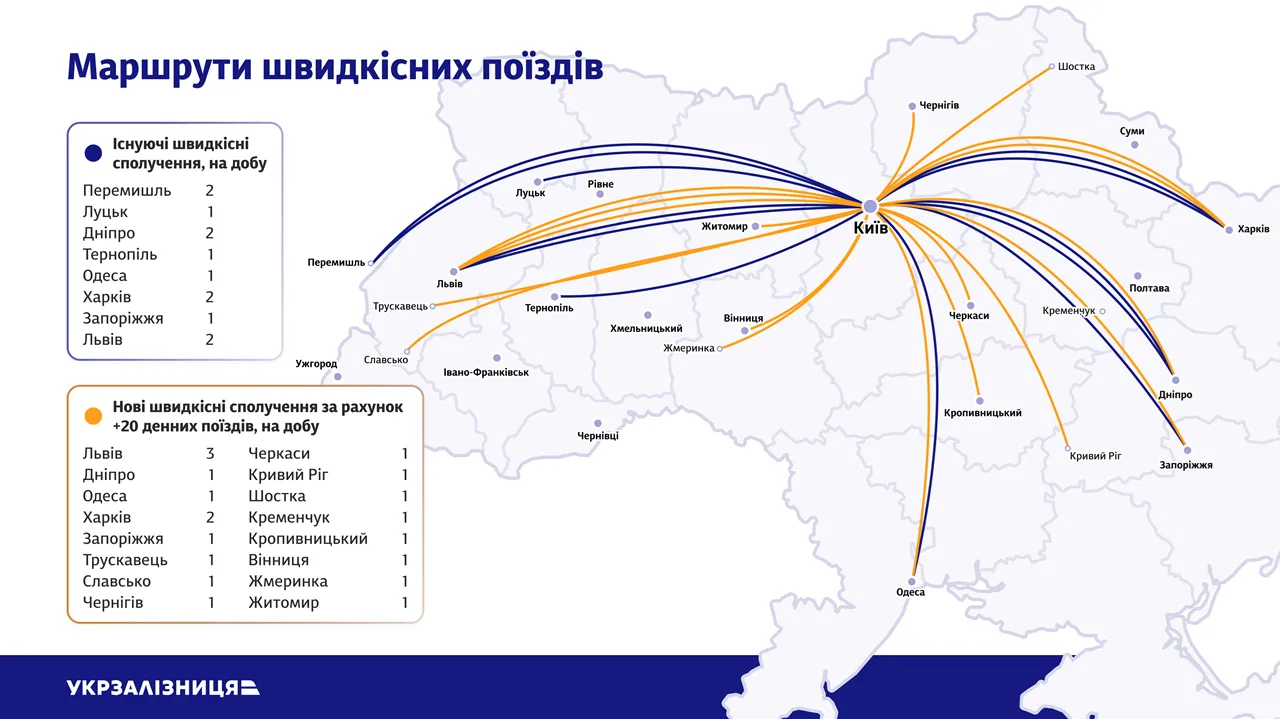
Increasing the share of daytime high-speed trains to 30% within three years and 40% within five years, enhancing operational flexibility, faster turnaround, and passenger comfort. For example, trains on the Kyiv–Lviv route could run every three hours, with more than 20 new high-speed connections planned.
Revamping regional services, since 27% of long-distance night train passengers actually require shorter routes of up to 300 km. Plans include developing new regional routes for electric trains (e.g., Kyiv–Vinnytsia, Kharkiv–Dnipro) and diesel trains (e.g., Lviv–Yasinia, Khmelnytskyi–Kamianets-Podilskyi).
To realize these ambitious goals, Ukrzaliznytsia calls for systemic government support, including funding for new railcars and Hyundai electric trains, as well as repair and modernization of existing fleets. The company also expects compensation from local budgets for chronically unprofitable suburban routes, which are to be ordered by local communities.
However, without state assistance, these plans are unlikely to succeed amid Ukraine’s economic downturn, decreased freight traffic, and Ukrzaliznytsia’s growing financial losses and debt burden.